By Grant de Graf
The ECB recently increased its key interest rate by a quarter of a percent to 1.5%, in response to rising inflation which measured 2.7% for June, above the central bank's target rate of 2%. ECB President Jean Claude has indicated that he will not hesitate to hike interest rates further, to constrain inflationary pressures.
Despite higher "inflation" levels, growth rates in Europe remain constrained, unemployment is high at 9.3% and economic sentiment has plunged.
Historically, inflation has occurred in times of rapid growth and the mechanism that policymakers have used to fight the one-eyed tiger, is through monetary policy, namely interest rates. The intent of central banks in dealing with inflation through interest rates, is to curtail monetary supply, which occurs through credit expansion.
There are two main weaknesses in this approach. Firstly, there is always a question of governments being able to define and calculate inflation accurately. For example, higher inflation in the EU this year, is more likely to be a function of rising commodity prices than credit or monetary expansion. This can be substantiated by the fact that inflation is normally accompanied by a decrease in unemployment as clarified by the Phillips curve, and this has not occurred. Consequently, the EU is trying to manage an inflation problem that does not exist.
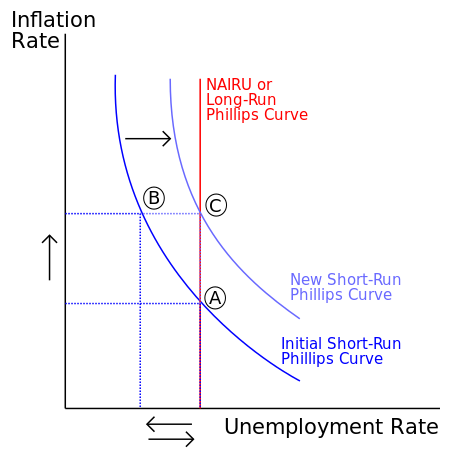
Secondly, using interest rates to control inflation runs counter to free-market theory, as setting the interest rate is subjective and randomly determined by policymakers. If the central bank gets it wrong, then they are effectively distorting the demand and supply curve for money, which could impact an economy, negatively.
Government-induced inflation (simplistically viewed as a function of printing too much money) normally occurs in periods of high growth, affording policymakers the ability to use interest rates to constrain credit expansion and slow economic activity. Europe is not experiencing a phase of high growth and therefore, increasing interest rates beyond the point of equilibrium (where the supply of money effectively meets demand), distorts the free-market adjustment mechanism within the economy that could automatically rectify an imbalance. Instead, the higher interest rates hamper efforts to facilitate growth and could plunge the EZ back into a recession.
The ECB now finds itself in a position where "inflation" is increasing, high rates of unemployment are on a rise and GDP levels are declining. Due to the negative impact that it may have on growth and levels of unemployment, using interest rates as an instrument to manage "inflationary" pressures, is no longer an option.
Your source to global events that impact the economic recovery and other musings for the not so faint-hearted.
Sunday, July 10, 2011
Saturday, July 9, 2011
Friday, July 8, 2011
Wednesday, July 6, 2011
Tuesday, July 5, 2011
Monday, July 4, 2011
Sunday, July 3, 2011
Thursday, June 30, 2011
Greece Passes Second Austerity Plan
Greece Passes Second Austerity Plan - WSJ.com
NewsOnABC: Calm has returned to the streets of Athens after the parliament approved a second austerity package to secure a payout from the European Union.
Canada's Reserve Bank Adopts Novel Approach to Housing Boom
By Grant de Graf
Mark Carney, the Governor of the Canada's Reserve Bank has adopted a novel approach in dealing with his country's rising housing prices. Cognizant of the impact that a housing bubble can have on an economy, many practitioners have opted to use the traditional monetary policy instruments, effectively interest rates and quantitative easing, to curb high demand and spiraling home prices.
However, these powerful tools have side-effects and are typically non-discriminatory in application. The impact that they have are broad reaching and while a central banker may be focused on addressing a single aspect of the economy, such as rising home prices, invariably the consequence of higher interest rates extends to other areas of the economic equation, such as consumer demand, currency, manufacturing and exports.
Therefore, Canada's Mark Carney's approach to dealing with rising home prices through increased mortgage bank and home-buyer regulation, should be welcomed. While increased regulation is usually a constraint to economic growth, Carney's action should be praised for being able to focus on a concern within the economy, which has the ability to foster a level-headed approach to pricing, with laser precision.
In a country such as Israel, home prices have enjoyed run-away levels of appreciation. As its central bank has responded by increasing interest rates to constrain the demand for homes and place a cap on prices, currencies in some instances have also strengthened, placing economic growth and exports at risk.
Many argue that increasing interest rates runs contrary to the classical free market policies advocated by economist Adam Smith, and that government intervention is precisely the action that could facilitate a recession. In any event, regulation in Mark Carney's sense of application, is closer aligned to free market thinking, than that of interest rate adjustment.
Mark Carney, the Governor of the Canada's Reserve Bank has adopted a novel approach in dealing with his country's rising housing prices. Cognizant of the impact that a housing bubble can have on an economy, many practitioners have opted to use the traditional monetary policy instruments, effectively interest rates and quantitative easing, to curb high demand and spiraling home prices.
However, these powerful tools have side-effects and are typically non-discriminatory in application. The impact that they have are broad reaching and while a central banker may be focused on addressing a single aspect of the economy, such as rising home prices, invariably the consequence of higher interest rates extends to other areas of the economic equation, such as consumer demand, currency, manufacturing and exports.
Therefore, Canada's Mark Carney's approach to dealing with rising home prices through increased mortgage bank and home-buyer regulation, should be welcomed. While increased regulation is usually a constraint to economic growth, Carney's action should be praised for being able to focus on a concern within the economy, which has the ability to foster a level-headed approach to pricing, with laser precision.
In a country such as Israel, home prices have enjoyed run-away levels of appreciation. As its central bank has responded by increasing interest rates to constrain the demand for homes and place a cap on prices, currencies in some instances have also strengthened, placing economic growth and exports at risk.
Many argue that increasing interest rates runs contrary to the classical free market policies advocated by economist Adam Smith, and that government intervention is precisely the action that could facilitate a recession. In any event, regulation in Mark Carney's sense of application, is closer aligned to free market thinking, than that of interest rate adjustment.
U.K Public Sector Stages Walkout
YouTube - Public sector workers walk out, in summer of discontent
Tens of thousands of public sector workers, including teachers and UK Border Agency officers, are striking for 24 hours over pensions.
Wednesday, June 29, 2011
Greece: Trojans and Spartans Return to Battle
By Grant de Graf
On June 22, 2011, I posted an article on "Why Greece Needs to Vote Against Austerity to Survive." In essence, I articulated a number of issues that would destroy Greece, if it chose to remain part of the Euro Zone and embrace the Euro. That message is no more clearer today, epitomized by the violent clashes that erupted on the cobble streets of Athens, in protest to the Government's austerity program. This is the same venue where Trojans and Spartans might have battled for freedom, in a era that was lost to time. Therefore, it is ironical that a similar struggle is being waged today.
This time the enemy is the European Central Bank, who chooses to impose its values and discriminating predisposed remedies, on a country and people that are gasping for survival. Its message is gift-wrapped with delicate tissue, proposing a manifesto that will provide the county with prosperity and economic recovery. The contents of the endowment is curried with a poison that tastes enchanting at first bite, but that will leave Greece with a legacy, handicapped and embattled for generations to come.
The biggest failure of the ECB has been its inability to implement fiscal and monetary policy simultaneously, from the same hand. The needs of local governments are so different to those of central government's and the discrepancies between the two, have in Greece's case, been irreconcilable. How can central government dictate to Greece a spending package that is largely a right that belongs to its citizens? How can central government deny it's members, participation in their own local affairs? How can central government actively restrain growth of a member's economy (which could potentially be activated through the development of its export industry) by forcefully compelling it to function with the Euro, as the official currency? Instead, Greece is being held to ransom, to be part of the Euro zone and retain the Euro.
In the end, both the Euro zone and Greece will suffer, as they grapple to fight the tide and reconcile a situation, the conclusion of which is inevitable.
On June 22, 2011, I posted an article on "Why Greece Needs to Vote Against Austerity to Survive." In essence, I articulated a number of issues that would destroy Greece, if it chose to remain part of the Euro Zone and embrace the Euro. That message is no more clearer today, epitomized by the violent clashes that erupted on the cobble streets of Athens, in protest to the Government's austerity program. This is the same venue where Trojans and Spartans might have battled for freedom, in a era that was lost to time. Therefore, it is ironical that a similar struggle is being waged today.
This time the enemy is the European Central Bank, who chooses to impose its values and discriminating predisposed remedies, on a country and people that are gasping for survival. Its message is gift-wrapped with delicate tissue, proposing a manifesto that will provide the county with prosperity and economic recovery. The contents of the endowment is curried with a poison that tastes enchanting at first bite, but that will leave Greece with a legacy, handicapped and embattled for generations to come.
The biggest failure of the ECB has been its inability to implement fiscal and monetary policy simultaneously, from the same hand. The needs of local governments are so different to those of central government's and the discrepancies between the two, have in Greece's case, been irreconcilable. How can central government dictate to Greece a spending package that is largely a right that belongs to its citizens? How can central government deny it's members, participation in their own local affairs? How can central government actively restrain growth of a member's economy (which could potentially be activated through the development of its export industry) by forcefully compelling it to function with the Euro, as the official currency? Instead, Greece is being held to ransom, to be part of the Euro zone and retain the Euro.
In the end, both the Euro zone and Greece will suffer, as they grapple to fight the tide and reconcile a situation, the conclusion of which is inevitable.
Subscribe to:
Posts (Atom)