Tuesday, July 26, 2011

Monday, July 25, 2011
Saturday, July 23, 2011
Friday, July 22, 2011
Thursday, July 21, 2011
Wednesday, July 20, 2011
Tuesday, July 19, 2011
Sunday, July 17, 2011
Private Sector Participation in Greek Tragedy Crucial for Successful Outcome
by Grant de Graf
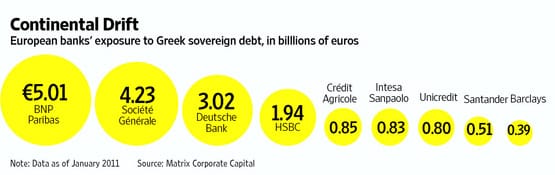
The forthcoming European summit, set to facilitate private sector participation in the Greek rescue is important. Failure to include bondholders in coordinating events, would make the bailout in essence, the provision of a rescue plan for investors, rather than a lifeline for Greece. The bailout needs funding that should be directed towards the revival of Greece's economy. It should not be a vehicle to buttress the pockets of investor's who are looking to call on a perceived surety that was provided by the ECB. In the long term this will be in the best interests of bondholders, as surely they are looking for a long term solution in which full capital can be redeemed - not a local anesthetic that provides temporary relief and doesn't deal with the cause.
The ECB's opposition to the government's plans for private-sector involvement is preposterous. Ostensibly, ECB officials fear a declaration of Greek default, even of a narrow kind, could cause a wider conflagration in financial markets. The reality is that the market has already factored in the bailout as a quasi-default. Clearly, there are other interests at play, and officials need to be weary of those at the ECB who toe this line.
Saturday, July 16, 2011
Eurozone Feeling the Stress - Inside Story
How credible are stress tests and what impact will they have on the Eurozone's economy?
Friday, July 15, 2011
PIIGS Secretly Wish to Ditch Euro

Factors that provide a framework to a pragmatic solution to the European debt crisis.
Despite several plans to resolve the bond crisis that is sweeping Europe, a solution that deals with the fundamental causes, continues to escape policymakers. This is because key players are focused on embracing a diplomatic solution that will achieve consensus, without considering the long-term practical implications that will result from their proposals . For example, the additional funding that is being provided by the ECB for Greece's bailout, may allow the Greek treasury a brief spite of relief. However, it does nothing to set the country towards a path of growth and recovery. (See Greece: Trojans and Spartans Return to Battle) In fact the punitive austerity measures that are being imposed on PIIGS by the ECB, only serve to protract recession and make the recovery nothing more that a pipe-dream. (See Austerity vs. Stimulus: Who is Winning the Race)
Regions that are caught in the European Debt crisis on the other hand, fear financial isolation and the inability to raise capital independently, hence their outward expressions to remain loyal to the Euro and to perpetuate their membership of the Euro zone. Secretly, they carry the heavy shoulders of remorse for having even considered ditching their local currencies and converting to the Euro currency. It has invoked an era of high prices, lower standards of living, unemployment and high debt ratios.
On the other hand, core policymakers of the European Parliament interpret consent to release PIIGS from the Euro and to revert to their independent currencies, as a failure of the Euro. This is not the case.
Releasing PIIGS from the Euro is the only chance that Europe has of saving the currency and failure to provide these regions with that alternative, will be the final decree that terminates the existence of the Euro forever. Whereas agreement for troubled economies to revert to their independent currencies may be viewed as failure, it is not. It is a positive that will allow the stronger countries of Germany and France to prosper under the auspices of the Euro, while providing weaker countries an opportunity to recover. Such economic reconstruction will need to be accompanied through the privatization of public assets to reduce debt, lower taxes, in addition to government and foreign expenditure programs that can capitalize on those regions unique strengths, respectively.
Separately, there has been some discussion about the possibility of the ECB forgoing a portion of the debt that it holds over Greece. This is ludicrous. To ensure that its assets are protected, the ECB will need to provide PIIGS with credit and assistance that it requires for recovery. Interest on debt needs to be rolled over and capitalized - PIIGS has already suffered significant damage to its credibility and the fact that it cannot service debt, has been factored in by the market.
Funds need to be made available for capital expenditure programs in the regions that will impact real economic growth and not for appeasing creditors, who are looking for a payback on their investments and from economies that are inefficient and virtually bankrupt. Further, advancing funds to Greece to pay interest on its bonds serves investors, but does sweet nothing towards resolving that country's economic hiatus.
The key person who will need to orchestrate a solution is new IMF head, Ms. Christine Lagarde. She understands the importance of providing a blueprint that will be encompassing and that will not deal with issues in a piecemeal fashion, as has been the case in the past.
DSK would have said, in support of her efforts to seek a remedy. "I wish you lots of mazel."
Plan B Emerges on Debt Ceiling
McConnell Debt Plan Gets Closer Look :
Sens. Reid, McConnell Quietly Discuss Way to Keep Government From Default
Thursday, July 14, 2011
Subscribe to:
Posts (Atom)