Saturday, July 30, 2011

Friday, July 29, 2011
Future of Euro's Sustainability is Vulnerable

Although I have previously expressed a level of confidence in the Euro (See Why the Euro Will Remain Strong), reluctance by the EU to recognize its own failings and implement necessary adjustments, will ultimately result in its own eulogy.
Not affording PIIGS an opportunity to revert to their independent currencies and release them from the strict fiscal discipline of the EU, will ultimately exacerbate the challenges the EU faces and thwart free-market adjustments in the economy, necessary for a sustainable recovery.
There are several factors that are preventing EU officials from pursuing a course that will facilitate a comprehensive strategy that will ensure the survival of the Euro and economic salvation.
- Firstly, several of the pundits are constrained by a limited understanding of the dynamics and fundamentals that are at play in Europe. Common mistakes and economic conclusions are being thrust on to the conference tables of the European Parliament and consequently, the impact which a rescue plan can have on a recovery is limited, if not downright dangerous.
- Secondly, decisions that are fundamentally supportive of a recovery are being sidelined in favor of political and other self-interests.
- And thirdly, there is a perception that austerity will resolve all economic ills. Clearly, a new dispensation is required, but a recovery requires investment into those specific areas that will contribute towards rapid and sustainable growth in GDP.
Thursday, July 28, 2011
Tuesday, July 26, 2011
Monday, July 25, 2011
Saturday, July 23, 2011
Friday, July 22, 2011
Thursday, July 21, 2011
Wednesday, July 20, 2011
Tuesday, July 19, 2011
Sunday, July 17, 2011
Private Sector Participation in Greek Tragedy Crucial for Successful Outcome
by Grant de Graf
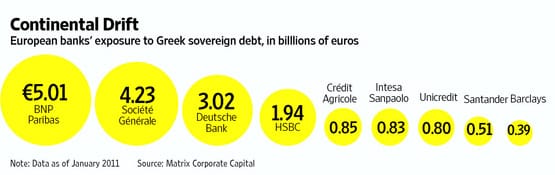
The forthcoming European summit, set to facilitate private sector participation in the Greek rescue is important. Failure to include bondholders in coordinating events, would make the bailout in essence, the provision of a rescue plan for investors, rather than a lifeline for Greece. The bailout needs funding that should be directed towards the revival of Greece's economy. It should not be a vehicle to buttress the pockets of investor's who are looking to call on a perceived surety that was provided by the ECB. In the long term this will be in the best interests of bondholders, as surely they are looking for a long term solution in which full capital can be redeemed - not a local anesthetic that provides temporary relief and doesn't deal with the cause.
The ECB's opposition to the government's plans for private-sector involvement is preposterous. Ostensibly, ECB officials fear a declaration of Greek default, even of a narrow kind, could cause a wider conflagration in financial markets. The reality is that the market has already factored in the bailout as a quasi-default. Clearly, there are other interests at play, and officials need to be weary of those at the ECB who toe this line.
Saturday, July 16, 2011
Eurozone Feeling the Stress - Inside Story
How credible are stress tests and what impact will they have on the Eurozone's economy?
Subscribe to:
Posts (Atom)